What is the resource?
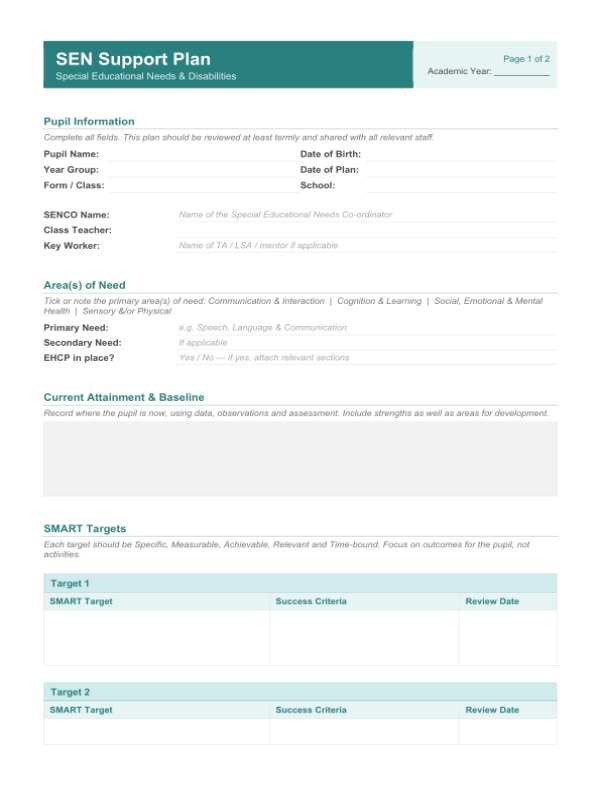
An Individual Education Plan (IEP) is a structured planning document that sets out tailored targets, strategies, and support for a child or young person with special educational needs. While IEPs as a formal requirement were replaced in England following the SEND Code of Practice 2015, many schools continue to use them — or equivalent documents such as SEN Support Plans — as a practical tool for planning, monitoring, and reviewing the provision they put in place for pupils with identified needs. A SEN Support Plan serves the same core function: to ensure that a pupil's needs are clearly understood, that specific and measurable outcomes are agreed upon, and that everyone involved in supporting the child is working towards the same goals. Both documents are rooted in the graduated approach to SEN support, which moves through four cycles: assess, plan, do, and review. A well-written IEP or SEN Support Plan begins with a clear and honest assessment of the individual's strengths and areas of difficulty, before setting a small number of focused, achievable targets that are specific, measurable, and time-bound. It details the strategies and interventions that will be used, the resources or staffing required, and the expected outcomes. Crucially, it also records the views of the child or young person and their parents or carers, ensuring that planning is collaborative and person-centred. A template supports consistency across a school or setting, making it easier for staff to produce high-quality plans efficiently and for leaders to monitor provision at a whole-school level. A good template prompts the writer to think carefully about what meaningful, functional targets look like, how progress will be measured, and how success will be reviewed and communicated to families.
Who is it for?
This resource is for SENCOs, class teachers, and teaching assistants responsible for planning and documenting SEN support. It is also useful for school leaders seeking to standardise and improve the quality of SEN documentation across their setting. Parents and carers may find it helpful for understanding what an effective plan should contain and what to expect when reviewing their child's support.
How it should be used
Complete the template collaboratively, drawing on assessment data, pupil voice, and parental input to ensure the plan accurately reflects the individual's needs and priorities. Set a small number of focused, meaningful targets rather than an exhaustive list, and ensure that every section is completed with sufficient detail to be actionable. Share the finalised plan with all relevant staff, parents, and where appropriate the pupil themselves, and schedule a review date at the outset. Revisit and update the plan at least termly, using the review to evaluate progress and adjust targets and strategies accordingly.