What is the resource?
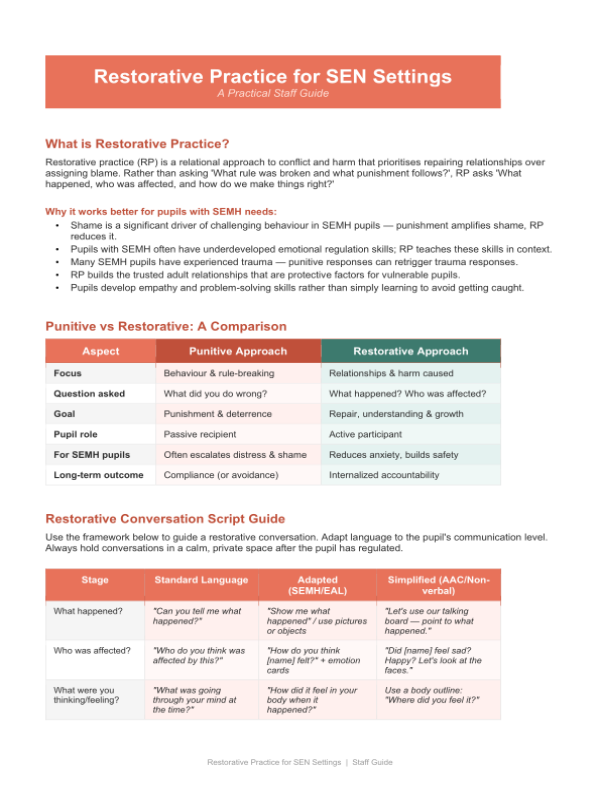
Restorative practice is a relational approach to managing conflict, repairing harm, and building community that prioritises understanding, accountability, and connection over punishment. Originating in restorative justice frameworks, it has been increasingly adopted in educational settings as an alternative to traditional sanctions-based behaviour management. At its core, restorative practice asks not "what rule was broken and what is the consequence?" but rather "what happened, who was affected, and what can be done to make things right?" In Special Educational Needs (SEN) settings, restorative practice takes on particular significance. Many children and young people with SEND experience higher rates of exclusion, misunderstanding, and disciplinary action, often as a result of needs that have not been adequately identified or supported. Behaviours that are rooted in anxiety, sensory overwhelm, communication differences, or emotional dysregulation are frequently misread as deliberate defiance. Restorative approaches create space for the individual's perspective to be heard and understood, and for relationships — between peers, and between pupils and adults — to be repaired thoughtfully and with dignity. Restorative practice in SEN contexts includes a range of tools and approaches, from informal restorative conversations to structured restorative conferences. It requires adults to develop skills in active listening, reflective questioning, and emotional co-regulation. Crucially, it must be adapted to meet the communication and cognitive needs of the individual — including the use of visual supports, simplified language, or alternative communication methods. When implemented consistently and with genuine understanding of SEND, restorative practice can reduce conflict, strengthen relationships, and foster a culture of empathy and mutual respect throughout a setting.
Who is it for?
This resource is for SENCOs, teachers, teaching assistants, pastoral leads, and behaviour support staff working in SEN or inclusive educational settings. It is also relevant for residential care workers and family support practitioners. It will be of particular value to those looking to move away from punitive behaviour management and towards more trauma-informed, relationship-centred approaches.
How it should be used
Use this resource to introduce or deepen understanding of restorative practice within your setting, and to explore how core approaches can be adapted for learners with a range of SEND needs. Begin with informal restorative conversations before progressing to more structured processes, and ensure all staff involved have a shared understanding of the principles. Always consider the individual's communication needs and emotional readiness before initiating any restorative process, and avoid using restorative approaches as a replacement for adequate SEND support.