What is the resource?
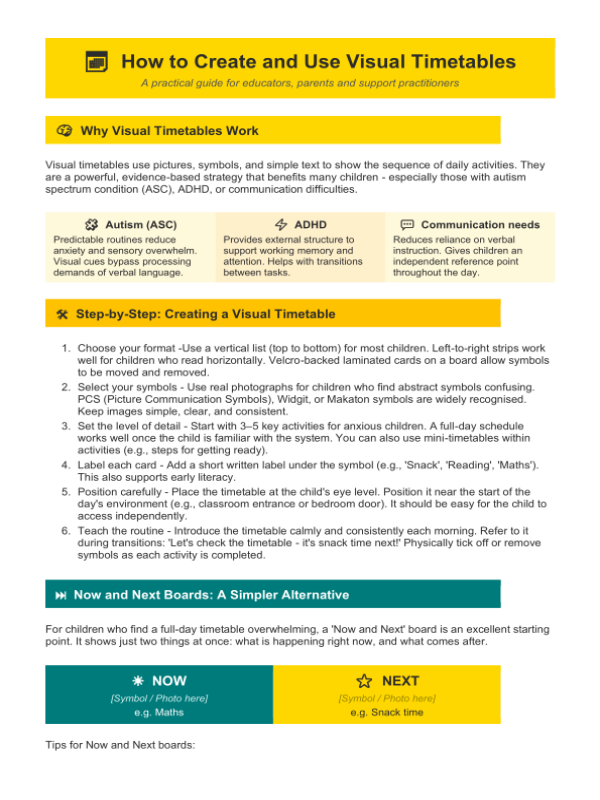
Visual timetables are organisational tools that use images, symbols, photographs, or icons alongside text to represent the sequence of activities or tasks in a day or session. Unlike written schedules, which rely on reading ability, visual timetables communicate information through pictures, making them accessible to a much wider range of people. They are typically displayed as a series of cards, strips, or boards — either physical or digital — that show what is happening now, what comes next, and what will follow later. Each activity is represented visually, allowing the user to process and anticipate their day without needing to rely solely on verbal instruction or memory. Structured routines are predictable, consistent patterns of activity that follow the same sequence regularly. Rather than leaving daily tasks open-ended or subject to frequent change, structured routines establish clear expectations about what happens and in what order. When combined with a visual timetable, structured routines become even more powerful: the timetable acts as a visible anchor that reinforces the routine and gives individuals a concrete reference point throughout the day. Together, these tools reduce uncertainty and anxiety by making the abstract concept of time more concrete and tangible. Knowing what comes next — and being able to see it — provides a sense of control and predictability. Visual timetables also support independence, as individuals can check their own schedule and transition between activities without relying heavily on adult prompting. They can be adapted for different environments including classrooms, therapy settings, and the home, and personalised to suit an individual's communication level and preferences.
Who is it for?
This resource is particularly beneficial for autistic individuals, children with ADHD, those with learning disabilities, and people with communication difficulties. It is also well suited to young children, individuals with anxiety, and anyone who benefits from predictability and visual communication. educators, therapists, and parents or carers supporting these individuals will find the guide, templates, and board especially practical.
How it should be used
Use the guide to understand how to build an effective visual set, then print or display the now and next board and timetable templates in a consistent, visible location within the classroom or home. Populate the templates with images or symbols that are meaningful to the individual, and review the schedule together at the start of each day or session. Update cards as activities change and encourage the individual to refer to the board independently to support self-management and smooth transitions.